A multi-billion-dollar detector industry is scrambling to contain what safety advocates are now calling the biggest consumer-safety scandal in decades - one bolted to the wall of almost every home in America.

Right now, in the overwhelming majority of American homes, there is a small plastic disc screwed into a hallway ceiling that the people below it believe is protecting them while they sleep.
It is not. Not the way you think.
Every year, carbon monoxide sends more than 100,000 Americans to the emergency room. It kills hundreds more in their beds, including many kids.
And here is the detail that has quietly become one of the most uncomfortable facts in the home-safety industry: the vast majority of those homes had a working carbon monoxide detector on the wall.
Not broken ones. Not expired ones. Not units with dead batteries.
Working detectors, with their reassuring little green lights glowing, doing exactly what they were designed and certified to do.
That sentence sounds hard to believe the first time you read it. It did to me.
So I spent six weeks talking to firefighters, HVAC technicians, and the safety advocates who have been petitioning the federal government to change the law.
What they told me does not just explain how a family can die beside a functioning detector.

There is a single figure written into the safety standard behind almost every detector in America. Once you understand what it actually permits, you will never look at the one on your own wall the same way again.
You see, almost every carbon monoxide detector sold in the United States is built to a safety standard known as UL 2034.
If you bought yours at a hardware store or a big-box retailer, or if it simply came already installed when you moved into your home, it meets that standard.
That is all it has to do to be legal, to be sold, and to earn the word “certified” on the box.
And here is what that standard actually permits - not in a leaked memo, not in a whistleblower’s files, but in the plain text of the rule itself:
Read that again. Not until carbon monoxide has climbed high enough to rob a healthy adult of the ability to think straight or walk in a straight line does the law require the device on your wall to make a single sound.

Everything you have just read assumes the detector on your wall will at least do the one thing it was built for: sound the alarm once carbon monoxide finally reaches that 70 PPM mark.
But most of the time, it won’t even do that.
The CDC took 30 of the most common carbon monoxide detectors in American homes - all functioning perfectly - and tested whether they actually sounded the alarm when they were supposed to.
57% of them - well over half - failed to alarm on time.
So this is not just a story about a standard that keeps your detector silent until the air is already dangerous. It is a story about detectors that, more than half the time, cannot even be counted on to speak up at the emergency they were built for.
So think about what that leaves bolted to your hallway wall: a device that is legally permitted to stay silent while carbon monoxide fills the rooms where your children sleep, and that, more than half the time, fails to sound even when it finally should.
It registers nothing, warns no one, and keeps its little green light glowing as if everything is fine. And none of it breaks a single rule.
This is not the regulations failing your family - this is the regulations working exactly as they were written.

The 70 PPM threshold was not written by doctors, or by anyone whose job was to keep people safe.
In the early 1990s, a wave of carbon monoxide call-outs in cities like Chicago and Los Angeles overwhelmed fire departments and gas companies.
The detectors were not the problem - they were doing exactly what they were built to do, catching carbon monoxide the moment they sensed it.
But answering those calls cost money and manpower. So the threshold at which detectors were required to sound was raised.
The 70 PPM standard was written, in large part, to stop the phones from ringing.
It was a solution to an inconvenience - not a standard built around the biology of the human body, and certainly not around the body of a child.
It was set more than 30 years ago. And in the decades since, it has not moved an inch.
And the manufacturers who build the cheapest possible sensor that can pass that 30-year old standard have every financial reason to keep it exactly where it is.
A better sensor exists. I wear one on my chest every single working day. It costs more to make. So the detectors on the shelf don’t use it - because nobody is required to, and the family in the store is comparing price tags, not sensors.
- David Kessler, HVAC technician, 26 years in the trade

Sarah Delaney did not go looking for a scandal. She went looking for an answer to a single, unbearable question: why didn’t their detector go off when their furnace leaked?
Sarah is 38. She lives outside Columbus, Ohio, with her husband Mark and their two children - Noah, 7, and Lily, 4.
Until one night last January, she had never thought about the carbon monoxide detector in her hallway for more than a second in her life.
It was on the wall. And that was the entire extent of her relationship with it.
The next part she tells slowly, because she has learned that if she says it too fast she starts to shake.
It was an ordinary Tuesday in the middle of a cold snap.
Their furnace - 5 years old, and, as far as anyone knew, perfectly fine - had been running hard for days. The kids went to bed at 8. She and Mark were asleep by 11.
Nothing was wrong. Nothing felt wrong.
That, she says now, is the part people do not understand about carbon monoxide: there is no moment where it feels wrong, up until it’s almost already too late.
What Sarah did not know, what no one in that house could have known, was that a hairline crack had opened along a seam in the heat exchanger of their furnace.
Not from age. Not from neglect. A crack like that can open on a furnace only a few years old, for no reason anyone would ever spot.

The HVAC technician who came out later took that photo - because from more than a few inches away, you cannot even see it.
It’s thinner than a single strand of human hair. That was all it took.
And that night, as the furnace ran, carbon monoxide slipped out through it, drifted up through the vents, and settled into the rooms where her family slept.
She was not woken by the detector. She needs people to hear that, because it is the entire point. At around three in the morning, she was woken by Lily - her 4-year-old - crying.
She tried to get up and go to her. But when she swung her legs off the bed to stand, she could not make her body work.
“I’ve never felt anything like it,” she says.
“My head was splitting. The room was tilting. I stood up and I actually fell back onto the bed, like I was drunk. I remember thinking - very slowly, like my thoughts were moving through mud - something is wrong with me. And then, right behind it: the kids.”
She got to Lily first, because Lily was crying and Lily was small enough to lift. Then she went to Noah’s room.
She could not wake him.
“He was breathing. But he was limp. I was shaking him and saying his name and he wouldn’t open his eyes.”
She stops here, every time. “I found out later why it was him and not me. Children go first. Their bodies are smaller, they breathe faster, and carbon monoxide reaches a dangerous level in a child long before it does in an adult.
My son was in far more danger than I was, in the same house, breathing the same air. I just didn’t know that yet. All I knew was that my little boy wouldn’t wake up.”
What happened next, she says, was not courage.
It was animal instinct running a body that could barely stand. She screamed for Mark.
She got the front door open. She carried both children out into 20-degree air in their pyjamas, no shoes, and stood in the driveway shaking so hard she could not hold the phone steady enough to unlock it.
The paramedics arrived within minutes. They put all four of them on oxygen in the ambulance. At the hospital, the carbon monoxide levels in their blood told the story the detector never had.
The doctor said if Sarah hadn’t woken up when she did - if Lily hadn’t started crying, of all things - they would not have woken up at all. Not the children. Not any of them. He said it in the calm voice they use, and I had to sit down on the floor of the hospital hallway.
- Sarah Delaney, 38, Columbus, Ohio
Everyone survived. That is the only reason this story exists to be told, and Sarah knows it. But survival was not the end of it.
Because once the fear receded, it was replaced by something that would not let her sleep for weeks - a single question, circling, relentless.
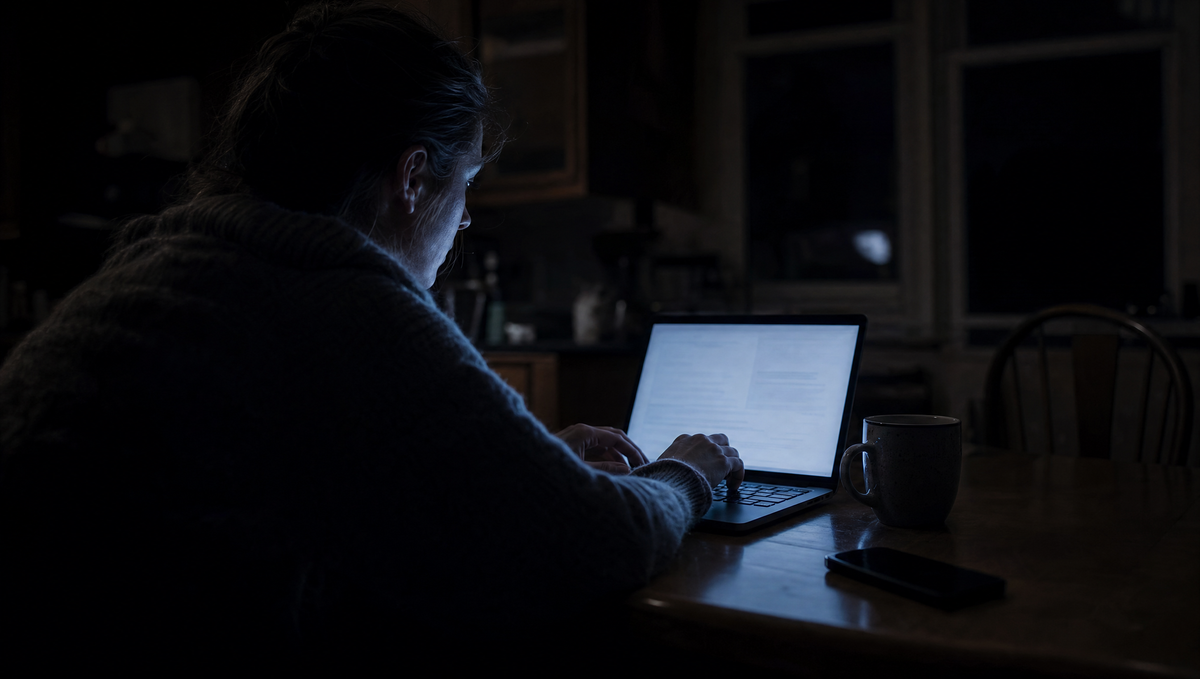
What Sarah found, in the small hours of the morning, was not one broken device. It was a decades-long battle the public was never supposed to find out about.
It started the way these things start now: a phone screen in a dark room, a woman who could not sleep typing a question she did not expect to have answered. Why didn’t her carbon monoxide detector go off?
The first answers were technical, and each one made her angrier than the last.
She learned about UL 2034.
She learned about the 70 PPM threshold - the point where her detector was finally required to make a sound, and not one moment before.
She learned about the CDC test that found more than half of the most common detectors failed to go off in time even at emergency levels.
And she learned that her detector had not failed - it had performed exactly to specification, and the specification was the problem.
But the deeper she read, the clearer it became that she was not the first person to discover this. Not by decades. She had simply walked into the middle of a fight that had been going on, quietly, for most of her life.
What she found, and what public records confirm, is this:
Read those three facts together and a picture assembles itself that is difficult to look at directly.
Doctors, lawyers, lawmakers, and grieving families have been trying - for years - to force a change to the standard. The people who write the rules already agree the standard is inadequate. And still it has not moved.
“That was the moment it stopped being about my furnace,” Sarah says.
“My family almost died in our sleep, and I found out that the people who could have prevented it have known for 30 years. Nothing changed because the way things are makes them money - and because fixing it would mean admitting that every detector they ever sold was built to let this happen.
I have never been so angry in my life.”

The firefighters and technicians who understand this loophole do not rely on the detectors from the hardware store. They never have.
Every professional I spoke to told me a version of the same thing. The instruments they trust do not wait for catastrophe.
They sound off early - long before carbon monoxide ever climbs to the level where a standard detector would finally react - and they show the actual number as it rises, because a person who works around this gas does not want to take any chances.
They want a warning while there is still time to act.
Until recently, that class of instrument was priced for professionals: the meters clipped to an HVAC technician’s chest run $400 to $600 dollars.
For an ordinary family, that put real protection out of reach.
Your only choices were the cheap plastic disc from the hardware store - or nothing at all.
That is what has changed, and it is why this story is reaching you now.
A company called Olyra has taken the same class of professional-grade electrochemical sensor the trade relies on and built it into a simple device that plugs into any household outlet.
The difference between it and the detector Sarah had on her wall is not a matter of degree. It is a different category of protection:
It’s the one I have on the walls in my own home, where my grandchildren sleep when they visit. After what I’ve carried out of other people’s houses, I was never going to trust anything less.
- Michael Ereford, Fire Captain (Ret.)

Sarah promised herself, standing in that hospital hallway, that she would never again take chances with this.
So after the furnace was repaired and the house was declared safe, Sarah put real protection on her walls. She put up 3 TrueDetects - one outside the bedrooms, one near the furnace, and one in the living room where the family spends its evenings.
For months, nothing happened. And then, on a cold morning in early spring, one of them went off.
It was not the shriek of a standard alarm arriving far too late. It was TrueDetect, sounding at 30 PPM - early, while the whole family was awake at the breakfast table, while every one of them could still think, still stand, still walk.
Sarah had the kids out the front door in under a minute. She called the gas company from the driveway. The technician found a failing flue connection - the early stage of the exact kind of fault that had nearly killed them in January.
But this time was nothing like January. No one was limp. No one was unconscious. No one was put on oxygen. They pulled on their coats and walked outside into the cold, together, and waited in the sun.
“The first time, we lived because our 4-year-old happened to cry at the right minute,” she says. “The second time, we didn’t need luck. TrueDetect was on the walls, and it caught the leak hours before it could have hurt us. That’s the whole difference. That’s everything.”
- Sarah Delaney, 38, Columbus, Ohio
I wish we’d had this for my dad.
My father passed in his sleep three winters ago. They called it his heart. It wasn’t until a neighbour in the same building got poisoned that we understood what really happened. I bought these for everyone I love the week I read about them. I am not burying anyone else over a silent box on the wall.
Denise R. ✓ Verified Purchase
It went off at 6 a.m. We got out.
Ours alarmed before sunrise on a Sunday. Half asleep, I almost told everyone to ignore it. The fire department found a cracked heat exchanger and said we had maybe an hour. My kids are asleep upstairs right now because of this thing.
Marcus T. ✓ Verified Purchase
Peace of mind outside the nursery.
New baby, older home, gas furnace. After what I read I couldn’t sleep. Now there’s one right outside the nursery, and every morning I can see the number is zero. Worth ten times what I paid.
Priya S. ✓ Verified Purchase
Bought three - one set for my parents.
My parents are in their 70s, still in the house I grew up in, with a detector older than my teenager. I put one in their hallway, one by their furnace, and kept one for us. I should have done it years ago.
Robert D. ✓ Verified Purchase
I’ve seen what CO does. This is the only one I trust.
I’m an ER nurse. I’ve watched families come in who “had a detector.” The day I understood the 70 PPM rule I ordered these for my house and my sister’s.
Rachel M. ✓ Verified Purchase

By now you are probably wondering the same thing Sarah did: how many of these does one home actually need?
Here is the honest answer…
Carbon monoxide does not fill a home evenly. It pools around the appliance that is leaking, then creeps room to room, floor to floor, at its own pace. A single unit down by the furnace tells you nothing about the air in your child’s bedroom two floors up.
That is why the firefighters and technicians who rely on these do not put up just one. They cover the map: one near the furnace or water heater, one on each level where people sleep, one near the kitchen and any gas appliance.
The rule they live by is simple. The more of your home you cover, the better.
So the real question is not whether to put one up. It is how much of your home you are willing to leave blind. Most families go with the 3 or 4-unit sets, and the ones with a bigger house, or parents sleeping down the hall, take the 6. Because once you understand what one hairline crack did to the Delaneys, covering one room and leaving the rest uncovered stops making any sense.
And whichever you choose, every order is backed by a 90-day money-back guarantee - so putting real protection on your walls tonight costs you nothing to try.

There is a reason you cannot just grab one of these next to the cheap discs at the hardware store.
The heart of TrueDetect is a professional-grade electrochemical sensor - the same class of sensor a hospital or an HVAC technician’s meter uses. It is expensive to produce, slow to manufacture, and genuinely difficult to calibrate accurately down to a single part per million.
For decades, that kind of sensor only ever came inside a $400-to-$600 handheld instrument. Olyra is the first company to get it into a simple device that plugs into a wall outlet in an ordinary home - and getting it there took years of work.
That is also why it will never sit on the big-box shelf. The same few brands that have controlled that shelf for 30 years, building to the 1992 standard, were never going to make room for the one device that exposes them.
It also means supply is limited. TrueDetect is built in small batches, and since word of all this began to spread, it has sold out again and again, often faster than Olyra can restock. If the sets are in stock when you look, that is the moment to secure them.
Free shipping · 90-day money-back guarantee · Connects to iPhone & Android

Before you close this page, do one hard thing with me.
Picture your own home tonight. The heat clicking on against the cold. Everyone you love asleep down the hall. And somewhere below them, an appliance that has run faithfully for years suddenly developing the kind of fault no one would ever see.
Now picture the detector on your wall doing exactly what the law allows.
Staying silent at 40 PPM. Staying silent at 50 PPM - the level where a small child simply does not wake up. Saying nothing, all night long, while the air in the rooms where your kids are sleeping slowly turns against them.
That is not a horror story. It is the documented, legal, everyday gap that put the Delaneys in an ambulance. And it is the reason thousands of families every winter go to sleep whole and do not all come back.
Sarah’s story has an ending she can live with, because a 4-year-old happened to cry at three in the morning. Most families never get that lucky. There is no cry at 3 a.m., no accident of timing - just a quiet house, and a sunrise that not everyone inside it wakes up to see.

Right now you are standing almost exactly where Sarah stood before that January night - except you have the one thing she didn’t. You know.
You know the alarm on your wall is built to speak only after it is already too late to matter.
You know more than half of them fail even then. And you know there is a device that speaks hours earlier, while your family is still awake, still able to get up and walk out the door.
You will not think about carbon monoxide again for months. That is exactly how it wins.
The only moment you can protect the people down the hall from it is a moment like this one - before anything has happened, while it still costs you nothing but a decision.
So make the choice Sarah wishes she could have made a single winter earlier.
Choose the set that covers your home. Put real protection on your walls tonight - and then go to sleep knowing that if the air in your home ever turns, something will sound the alarm long before it is too late to answer it.
It is backed by a 90-day money-back guarantee, so the only thing you stand to lose tonight is the risk of doing nothing.
Sarah still keeps the old detector in a drawer. She says it is a reminder that it was doing its job the entire time - and that its job was never going to be enough.
Please don’t find that out the way she nearly did.
Free shipping · 90-day money-back guarantee · We deliver across Canada in 6 to 12 days
The author is a paid spokesperson and this article is written in the voice of a persona for illustrative purposes.

