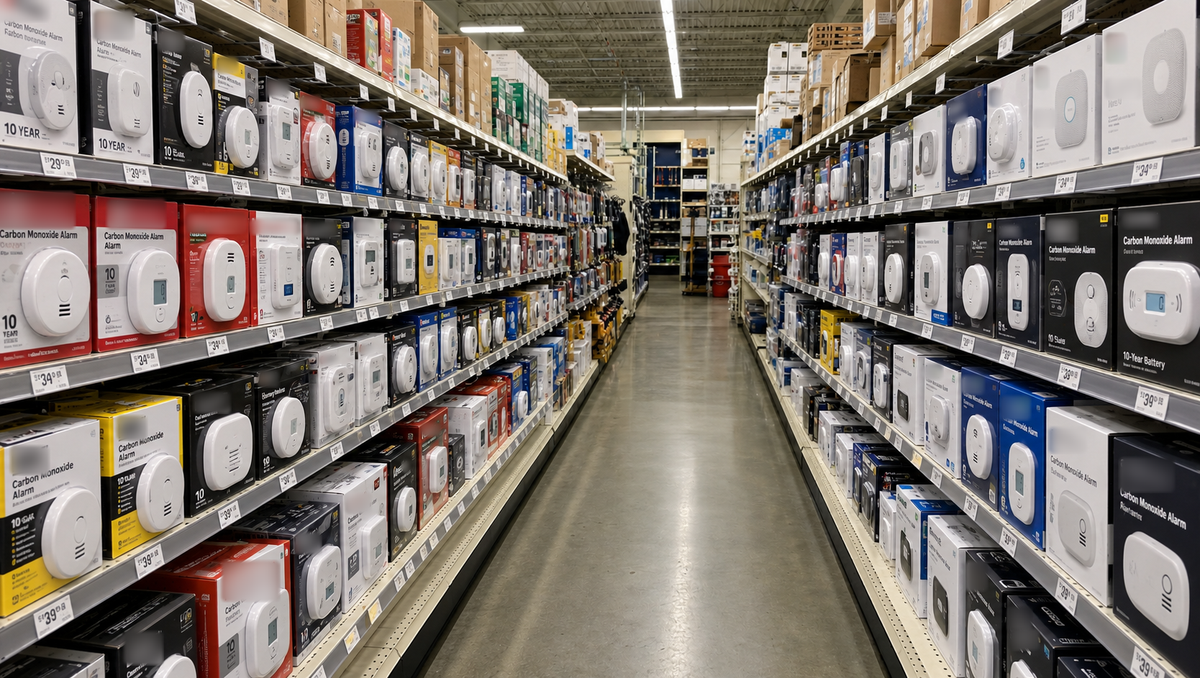
90% of American Homes Have a CO Detector. So Why Are 100,000 People Still Poisoned Every Year?
I spent 3 months investigating that question. What I found should be illegal: The CO detector in your home wasn't built to warn your family before it's too late. It was built to meet an outdated minimum code.
By Sarah Isaacson
Safety hazards investigator · September 10, 2026
Most Americans are aware of the silent killer… they've seen the horror stories on the news hundreds of times.
And that awareness is a good thing…
It made the US the highest-adopting country for carbon monoxide detectors in the world, with almost every single home having a few installed.
The problem is, despite each of us making the effort to purchase and install detectors in our homes, the numbers show carbon monoxide poisoning is almost as likely to happen to you as if you didn't have a detector at all….
With over 100,000 carbon monoxide poisoning cases last year alone.
So it begs the question:
If every single one of us has a detector, why are our chances of our family surviving a carbon monoxide poisoning so low? Isn't it as simple as: if there's a CO leak, the alarm will go off, and we'll evacuate before danger?
My investigation discovered that it isn't. It's supposed to be like that, but it isn't.
So if you heat your home with gas, listen closely. Especially if you have kids at home.
The Law Says 70 PPM. Science Says Something Very Different.
In 1992, the U.S. government established the minimum legal alarm threshold for carbon monoxide detectors to be 70 parts per million (PPM).
That means, CO detectors are legally allowed to have sensors that can't detect below 70 PPM.
However, in the years following that ruling, researchers began publishing findings that painted a very different picture of what carbon monoxide actually does to a human body.
At 35 PPM, OSHA's own data documents severe headache and dizziness with constant exposure.
At 50 PPM - still well below the legal alarm threshold, exposed individuals reported loss of judgment, loss of vision, dizziness.
At 60 PPM, adults could not think straight, could barely stand up without falling, and some lost consciousness. Most kids completely lost consciousness at that point.
These weren't fringe studies. They were replicated across independent research teams over decades.
Survivor after survivor reported the same terrifying detail:
By the time the alarm finally sounded, they were already too weak to move. Too disoriented to find the door. Too far gone to carry their own kids outside.
This led to several lobbying wars in the last few decades.
Advocacy groups testified before state legislatures.
Survivors sued detector companies.
Physicians who'd treated poisoning victims signed and funded petitions demanding the threshold be lowered.
As recently as the end of 2024, the National Carbon Monoxide Awareness Association (NCOAA) filed another petition, the biggest one. And this one was backed by several members of the Consumer Product Safety Commission itself.
But, still, none of it worked. The law stayed the same.
The Reason Every Petition Failed (Who Actually Benefits From Keeping It at 70 PPM)
Why would decades of science, dozens of petitions, and even members of a federal safety commission fail to move a single number?
The answer has almost nothing to do with safety. It has to do with money.
Ever since 1992 when the law came out, detector manufacturers have hired the best lawyers and lobbied to keep the threshold where it is.
Their argument, made to regulators and state legislatures, is a logical-sounding one:
If detectors are required to detect lower levels, their sensors become significantly more expensive to manufacture. And if they cost more, fewer families will buy them. And fewer detectors in homes means more deaths, not fewer.
And that argument was enough to allow them to play regulatory games that kept regulators from acting.
Every time a legislative push got close, the industry spent what it needed to slow it down.
The result?
The detectors on store shelves are still only required to alarm at 70 PPM…
The manufacturers make maximum profits selling minimum-code, cheap sensors…
And 100,000 Americans get poisoned by carbon monoxide every single year.
But One Company Decided To Do Something About It
When a safety tech company called Olyra was doing research to consider adding a carbon monoxide detector to their product line, they discovered an opportunity.
They saw the chasm between what the science said was dangerous and what the detectors were actually built to catch.
They saw the study where more than half of America's most common detectors failed the test.
And they saw the number underneath it all: 100,000 people, every year.
Most companies would have built the cheap version to have similar profit margins as their competitors. But Olyra did the opposite. They built the detector to the level the science demanded, the level that actually gives a family time to get out. Not the level the law lets you get away with.
It nearly bankrupted them. The sensor it took to catch carbon monoxide that early cost four times more than a minimum-code unit.
But their bet was simple, and it was right:
Build the one detector that actually saves lives, and the families it saves will spread the word about it. When the word spreads. The money will follow.
And that's exactly what happened. Today, TrueDetect is considered one of the most important safety devices of the decade.
★★★★★
Saved my life!
This thing literally saved my life. I had a headache and my son felt sick for an hour and then TrueDetect alarmed. We quickly exited the home. My old detector? It was still on the wall but never made a damn sound. If I didn't have this, we would've gone to sleep and that would've been it. Be smart and get your home protected as well.
Jenna R.
★★★★★
After what happened to my friend's daughter, this was non-negotiable
My friend lost her 7 year old to CO poisoning last year. She told me to get this one as she did. I did. Honestly I sleep better now. The app is a nice bonus too. Really impressive device. Highly recommend.
Paula M.
★★★★★
Got CO Poisoned Because My Detector Failed. Never Again.
Was CO poisoned two years ago. I was lucky that my wife got back home and found me. My detector certainly didn't beep. Bought TrueDetect the same week. This is the only one that can give me peace of mind after what happened. And I thought to write this review now, because I hate to think that some people will wait until it happens. Don't be that person. Especially if you have kids, don't rely on luck. Get your home protected.
Mark D.
What TrueDetect Actually Does, And Why It Saves So Many Lives
Standard CO detectors give you one piece of information: whether CO levels have crossed 70 PPM.
But as you already know by now, at 70 PPM your chances of survival are slim. Especially if you are asleep. Especially if you have kids at home.
That's why TrueDetect alarms at 30 PPM, not 70.
30 PPM is hours before carbon monoxide starts threatening your family's life - when your head is still clear, and you can still get your kids up and out of the house.
And to make sure there is no chance you won't hear the alarm, TrueDetect can connect to all the smartphones in your home with one click of a button. So once a leak happens, all the phones in your home will go off with a loud alarm. Even on silent mode. And even if you are not at home.
But what I like about TrueDetect the most, is that it also shows the exact CO level on a screen, from just 1 PPM. So you catch a slow leak when it just shows up as chronic fatigue, headaches, or the flu (Which can happen for weeks or even months before an emergency).
You just plug it into any outlet in a few seconds, and it immediately starts monitoring your air 24/7 for a full 10 years. Not 5 years like standard detectors - 10 years. And it will send you a notification once it reaches the end of its life.
Nearly a third of homes are running on an expired detector right now and have no idea. With TrueDetect, you'll never be one of them.
If You Heat Your Home With Gas, This Isn't Optional
I'll be blunt, because this is your family's life that we're talking about, and the research left me no room to be gentle.
The detector on your wall was almost certainly built to the 70 PPM minimum. Which means if your furnace, water heater, or any fuel-burning appliance leaks tonight, your detector won't go off until the point you can't evacuate the house anymore.
You don't get a second chance with carbon monoxide. There's no "we'll catch it earlier next time." There's the night it happens, and whether your detector warned you in time or didn't.
So do not take that risk.
Don't put your family's life in the hands of a detector that most likely won't help your family when they need it most.
You are risking nothing when getting TrueDetect to protect your family.
Olyra backs every unit with a 90-day money-back guarantee.
So if you're not convinced it's the protection your family should've had all along, or if you simply don't like it for any reason, you send it back and get every penny you paid back.
The risk sits with them, not you.
The Only Risk You Face Is One Of Pain And Regret If You Don't Act Now
The coldest months of the year, when 90% of CO poisoning deaths happen, are almost here.
And the problem is, when your furnace runs for weeks straight, it doesn't need to break to fill your home with carbon monoxide. Just a hairline crack that suddenly forms overnight is all it takes.
Carbon monoxide gives no warning. You can't see it, you can't smell it, you can't taste it.
The only thing you can do is make sure that if, God forbid, something happens in your home on a cold day, your family will survive without any harm.
How I see it, you have two options. And each one has a completely different consequence.
Option 1:
You tell yourself that a sudden CO leak won't happen in your home - that a furnace can't suddenly crack, a flue can't suddenly shift, an appliance that ran fine for years can't suddenly fail - and you decide to keep the minimum-code detectors you have.
And maybe you'll get lucky. Maybe your family won't fall victim to carbon monoxide this winter, and winters to come.
But if you don't get lucky… If carbon monoxide starts filling your home one cold night… your family won't know until it's too late. They'll either sleep through the alarm as 70 PPM of CO already got them into deep sleep… Or they will wake up but too dizzy and confused to find the door.
So think about this option deeply… Because that's a night you don't get to redo.
Or, you can simply go for the safe option…
Option 2:
You can decide to not take any risk with your family's life, and give them the real safety they deserve during these cold months.
You can finally experience the peace of mind that comes with knowing your family is truly safe in their home… without ever thinking about the silent killer again.
No more wondering if your appliances are releasing carbon monoxide.
No more wondering if your family will be safe in case of a serious leak.
From the moment you plug TrueDetect across your home, you will know what's in your air.
You will know the exact CO levels in your home - whether it's levels that can make you feel awful for months, or whether it's levels that can turn fatal within a few hours or days.
Your home will become what it was supposed to be all along - the safest place in the world for you and your family.
A safe, peaceful place you don't wonder once of whether your family is safe in it. You know they are.
And you'll feel satisfied with yourself, knowing you took responsibility and did what's needed to keep your family safe.
Knowing you left no chance for having pain and regret for making the wrong decision.
This is the life waiting for you on the other side of that simple decision to get TrueDetect for your home.
Remember - you've got nothing to lose.
You either absolutely love TrueDetect and the safety it provides for your family, OR you get your money back.
It's a win-win.
Either way, after learning what you learned today, you can't just do nothing about it.
While it's not your fault that you didn't know the detector in your home was set to a standard that makes your family vulnerable, it's now your responsibility to fix it.
I still thank God every day that I discovered TrueDetect. It's the only thing that ended the anxiety I had after those 3 months of research.
It gave me peace of mind.
And I'm just one of thousands of people who will tell you that.
You owe it to yourself and your family.
It's time to do the smart thing, the right thing for you and your family, while you still can.
I managed to get an insane discount after I told Olyra's team that I am going to publish this report. So you're very lucky you discovered it here today.
Note, the discount is only available on the link they provided me with, and I can only provide it here.
So click the button below to apply your discount and secure real safety for your family.
Advertisement. This page is an advertisement and not a news article, blog post, or consumer protection update. The author is a paid spokesperson and this article is written in the voice of a persona for illustrative purposes.
Testimonials reflect individual experiences and are not a guarantee that anyone will obtain the same results. Carbon monoxide detectors are safety devices, not medical devices, and nothing on this page is medical advice. If you suspect a carbon monoxide leak, leave the building immediately and call your local emergency number.